Motorhoming in Europe
The Best Way to Meet Your European
Neighbors
By Steve
Hunt
|
|
Experience the freedom of travel by motorhome in Europe.
|
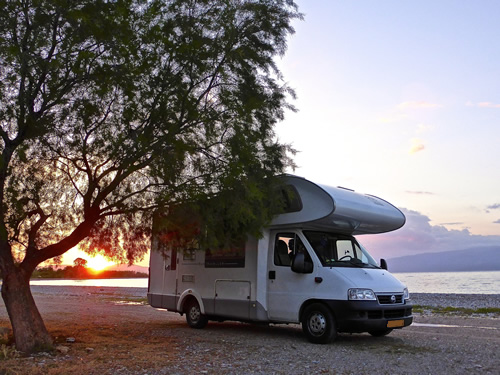
I have completed an 8-month trip across Europe by motorhome. As a former tour operator, I have traveled almost every imaginable way. I found motorhoming hard to beat. You pack once; you travel where you want when you want; you have no worries about where the next hotel room will be, and you have to try hard not to meet people.
A motorhome may not be ideal if you travel to Europe on a 2- or 3-week vacation. Some wrong turns on unfamiliar roadways can cause problems for people on a tight schedule. But it's ideal for a family exploring Europe for the summer or a retired couple with plenty of time. So why didn't I meet more Americans in over 9,400 inspected European campgrounds?
First, let’s look at the basics. There are three ways to acquire your camping van or motorhome:
The least expensive way to go
on a long trip is to buy. You can buy from an outfit that will guarantee to buy back your rig at the end of the trip. For optimum savings, consider a good used motorhome with low mileage. I contacted an outfit in Amsterdam recommended to me by an experienced RVer and made my arrangements over the phone. When I arrived, my camper was ready and waiting. I even shipped several cartons of supplies in advance, which were stored in the motorhome until I arrived. There are some technicalities regarding insurance and registration, but these are handled by the outfit that sells you your camper.
I met many Americans traveling in Europe who had considered motorhoming. Still, I decided against it because they feared being stuck with the motorhome at the end of their trip. The buy-back program (see box out below for leases and buy-backs) resolves this dilemma. Many companies will agree to sell your camper on consignment at the end of your journey, but I found most people wanted the security of a guaranteed buy-back. Buy-backs vary but usually average around 65 percent of the purchase price. The longer you travel, the cheaper the cost per day. Reasonably used motorhomes and camper vans ideal for touring Europe range widely between $20,000 and $90,000 depending on size, year, condition, desired luxury amenities, and the country in which you find and purchase the vehicle.
Leases often involve a smaller cash outlay depending on the length of your travel.
Europeans love to camp and there are
campgrounds just about everywhere. They range from complete destination resorts with swimming pools, tennis, entertainment, bars, restaurants, and grocery stores on-premises to more rustic campgrounds with few extras. Almost all campgrounds have necessities such as bathrooms, showers, dishwashing facilities, electric hook-ups, and chemical toilets for waste. Many people find a central location they like and take day trips using the campground as a base until they move on.

|
|
A young camper in Italy savors Florence's
delights from the back door of her family's motorhome. Photo by Steve
Hunt.
|
Costs
If you take the cost of your camper (minus buy-back or anticipated resale price), insurance, registration, campground fees, and gas, you can get a good idea of your costs. My costs over 245 days at the time of my writing, traveling an estimated 16,500 kilometers, were 1,678 euros for gas (check current fuel prices by country here), 1,452 euros for insurance (motorhome insurance information can be found online and is often U.K.-based), and 932 euros for registration (usually handled during purchase or lease). Campgrounds averaged 15 euros and €40 per night depending on location and total family members and include electric hook-up and charge for the camper. Your mileage may vary depending on the area, the strength of your currency, and current variable costs, especially gas.
Some people save money by free camping (camping in truck stops, beaches, and along the road), but I do so only in an emergency and don't recommend it as a standard practice. Besides, you miss one of the significant advantages of camping in Europe. It's hard not to socialize and meet people when you're in a campground. Fellow campers will be intrigued by the fact that you're an American camping through Europe. I can't count when people invited me for a glass of wine and conversation. And if you are traveling with kids, you'll be amazed how they communicate through body and sign language as if talking didn't matter.
Spend Time with a Local Family
Another way to add meaning to your trip is to allow some time for visiting with a local family. Servas, an organization of 15,000 international hosts (7,000 in Europe) in over 100 countries, will provide host lists for the countries you request. The normal routine is to spend two nights at the home of a host family, usually including dinner. The objective is to learn about each other’s way of life and exchange ideas. Some hosts will give you a tour of the local area, and all can provide helpful information. Servas charges nothing except a membership fee, but the usual procedure is to thank your host with a small gift or bottle of wine. A variety of such hospitality and home exchanges exist with members worldwide.
Travel Preparation
Finding space in campgrounds is much easier than finding space in hotels (although at popular vacation destinations in July and August, it’s helpful to call ahead and reserve a spot). Not all campgrounds take reservations, so the best bet is to arrive early if the area campgrounds are crowded. I never made a reservation during my eight months of travel and was only turned away twice because a campground was full. In both cases, I got a spot at a neighboring site. I also tried to arrange my itinerary to avoid crowded vacation destinations during the summer.
A good campground guide is essential for locating places you want to stay. Another essential item to get before you leave is a Camping Card International registration. "The international ‘passport’" for campers registration provides admittance to over 3,000 campgrounds (in some cases at reduced rates). See the box out below for a listing of websites and books on camping in Europe and other services and suggestions.
Proper planning is the best insurance for a smooth travel experience in Europe.
Motorhoming & RV Camping
Tips and Resources for Europe
Tips
Propane Tanks: Your camper will undoubtedly come with one full propane tank (used for refrigerator, hot water, and sometimes heater) and possibly a tiny reserve "camper" tank. If you're traveling for over two months, get a second full tank from your camper outfit. This backup gives you plenty of time to replace your empty tank when it runs out at the most inopportune time.
Electric Heater: Get a tiny electric heater in Europe. It saves on propane during chilly nights; you plug in at the campground.
GPS: Hand-held or dash-mounted, these can be indispensable if you find yourself lost or wish to find an obscure location with peace of mind. Of course, you can use your smartphone if your plan works in Europe, as most do for a cost.
Money: ATM
cash machines are generally the easiest and least expensive
way to obtain cash in Europe, and are everywhere
in Western Europe.
internet Access: For many, connectivity is crucial these days. Most campsites now offer WiFi. Public WiFi is also available in stores and chains as you travel. Consider using VPN (Virtual Private Network) software for additional security. Many other mobile internet possibilities are coming online all the time.
TV via streaming or satellite: If you're on a long trip, this is a great way to keep in touch with what's going on via CNN, BBC, etc. Many campers have access, and you can also stream content via WiFi these days.
Useful Websites
Caravan and Motorhome Club lists over 300 caravan and motorhome campsites in Europe in 14 countries. The website offers many savings and ideas for using your camper in Europe.
ACSI
Eurocamping is a site with a search engine
listing more than 9,400 inspected campsites in Europe in over 30 countries, including those where caravans and motorhomes are allowed. You can also purchase on their site the ACSI off-season
discount camping cards.
Helpful Books
The Complete Guide to Motorhoming in Europe: Make Touring Europe with a Motorhome or Campervan Easy with this Practical Vanlife Travel Handbook. An in-depth guide to Motorhoming or Campervaning
in Europe, regardless of the link of your trip. All the practical details you need to know, as well as driving itineraries for the most popular countries in Europe.
An American Couple’s Travels in Europe — Mostly by Motorhome. Follow a couple who sold all their possessions and then set out on a journey from Amsterdam to Southern Europe, learning about visas, driving laws, navigating the roads, and providing lists of helpful campsites. They also describe tips about cultural differences as they drive their motorhome from country to country.
Touring Europe 2022: in a caravan, motorhome or tent and over 3500 campsites reviewed. 3500 campsites reviewed in-depth by remmondations, visitors,
and reviews by members of the UK Caravan and Motorhome Club, listed above as a useful website.
Key Resources
AutoEurope: RV and Motorhome Rentals in Europe
Renting or Buying an RV (Campervan/Motorhome) in Europe — Good article on buy-back and other options.
Harro in Europe and their Facebook page (Buy-backs offered along with other services.)
|
STEVE HUNT is a
professional tour operator who has traveled extensively in Europe by motorhome.
|


'%3e%3cg id='Final-Copy-2_2_' transform='translate(1275.000000, 200.000000)'%3e%3cpath class='st0' d='M7.4,12.8h6.8l3.1-11.6H7.4C4.2,1.2,1.6,3.8,1.6,7S4.2,12.8,7.4,12.8z'/%3e%3c/g%3e%3c/g%3e%3c/g%3e%3cg id='final---dec.11-2020'%3e%3cg id='_x30_208-our-toggle' transform='translate(-1275.000000, -200.000000)'%3e%3cg id='Final-Copy-2' transform='translate(1275.000000, 200.000000)'%3e%3cpath class='st1' d='M22.6,0H7.4c-3.9,0-7,3.1-7,7s3.1,7,7,7h15.2c3.9,0,7-3.1,7-7S26.4,0,22.6,0z M1.6,7c0-3.2,2.6-5.8,5.8-5.8 h9.9l-3.1,11.6H7.4C4.2,12.8,1.6,10.2,1.6,7z'/%3e%3cpath id='x' class='st2' d='M24.6,4c0.2,0.2,0.2,0.6,0,0.8l0,0L22.5,7l2.2,2.2c0.2,0.2,0.2,0.6,0,0.8c-0.2,0.2-0.6,0.2-0.8,0 l0,0l-2.2-2.2L19.5,10c-0.2,0.2-0.6,0.2-0.8,0c-0.2-0.2-0.2-0.6,0-0.8l0,0L20.8,7l-2.2-2.2c-0.2-0.2-0.2-0.6,0-0.8 c0.2-0.2,0.6-0.2,0.8,0l0,0l2.2,2.2L23.8,4C24,3.8,24.4,3.8,24.6,4z'/%3e%3cpath id='y' class='st3' d='M12.7,4.1c0.2,0.2,0.3,0.6,0.1,0.8l0,0L8.6,9.8C8.5,9.9,8.4,10,8.3,10c-0.2,0.1-0.5,0.1-0.7-0.1l0,0 L5.4,7.7c-0.2-0.2-0.2-0.6,0-0.8c0.2-0.2,0.6-0.2,0.8,0l0,0L8,8.6l3.8-4.5C12,3.9,12.4,3.9,12.7,4.1z'/%3e%3c/g%3e%3c/g%3e%3c/g%3e%3c/g%3e%3c/svg%3e) Your Privacy Choices
Your Privacy Choices